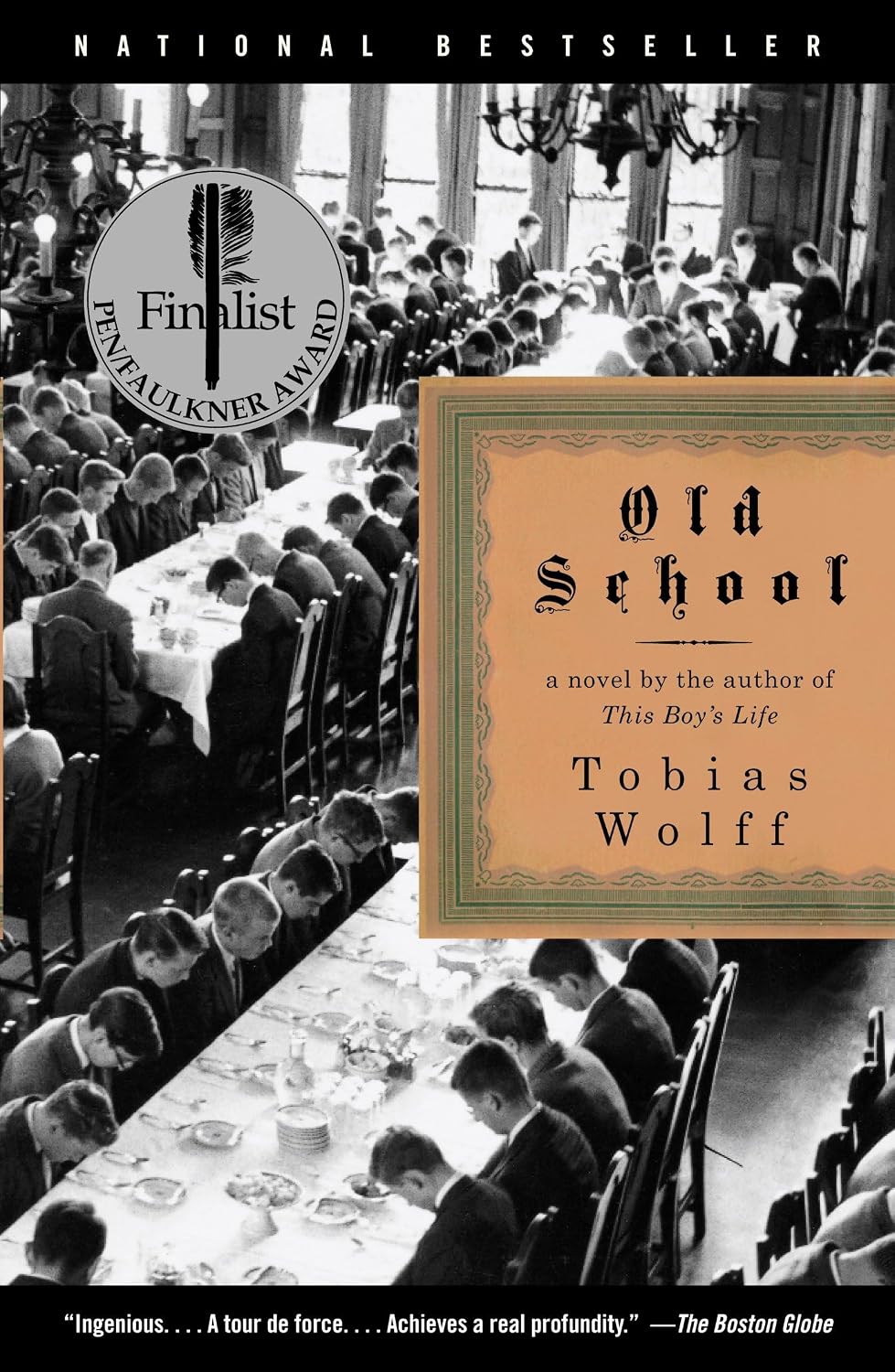
Before I moved into my condo last year, I gave away books that I had had a long and never read. I’d finally realized I never would. But there were some books I still kept, determined to read them. This month’s Writer’s Book Club reviews one of those books that I kept and finally finished–Old School written by Tobias Wolff and published in 2003.
I thoroughly enjoyed this short (195 pages) coming-of-age novel about a boy in a exclusive prep school in 1960, which was a finalist for the Pen/Faulkner Award.
The protagonist (who’s never named) wants to prove himself as a writer by winning the honor of a private meeting with a visiting poet or novelist. To do this, he must submit a written piece–poetry if the guest was a poet, fiction if the guest was a novelist. These weren’t ordinary guests. The first year, the school hosted Robert Frost. The next, Ayn Rand. And the third year, Ernest Hemingway.
What I liked about Old School
Tobias writes insightful things about the works of Frost, Rand, and Hemingway–things I didn’t realize myself. For example in Old School, the headmaster told his impressions of reading Frost’s “After Apple-Picking”:
“He [the headmaster] approached it, he said, in a surly humor. He’d done more than a bit of apple-picking himself and was sure this poem would make it fancy and romantic and get it all wrong. Yet what struck him first was how physically true the poem was, even down to that ache you get in the arch of your foot after standing on a ladder all day–and not only the ache but the lingering pressure of the rung. Then, once he’d assented to the details, he was drawn to the poem’s more mysterious musings. What was that pane of ice about? Which part of the poem was dream, and which part memory? When he borrowed the book he’d had no idea where this act would lead him. Make no mistake, he said: a true piece of writing is a dangerous thing. It can change your life.”
I also appreciated the protagonist’s vulnerability when he desperately wants a private audience with Hemingway and how his actions tragically connect him to the beloved headmaster.
And the historical aspects of this book are expertly woven in throughout the story such at the beginning:
Robert Frost made his visit in November of 1960, just a week after the general election. It tells you something about our school that the prospect of his arrival cooked up more interest than the contest between Nixon and Kennedy, which for most of us was no contest at all. Nixon was a straight arrow and a scold. If he’d been one of us we would have glued his shoes to the floor. Kennedy, though–here was a warrior, an ironist, terse and unhysterical.
What I didn’t like about the novel
It’s been several weeks since I read this slim book, and I don’t remember much about not liking it. But I vaguely remember wishing the protagonist had expressed more remorse for his actions. Perhaps he does, and I just missed it.
I wanted more (which isn’t necessarily a bad thing)
Honestly, I’d love to see someone make a movie of this book.
How Old School has affected my writing
It’s renewed my interest in the works of Frost and Hemingway in particular, and I look forward to reading more of their writings. Do you a favorite Frost poem or Hemingway novel? If so, let me know!
I give Old School 👍🏻 👍🏻 👍🏻 👍🏻
for realistic and vulnerable characters and terrific insight into that era.

What happened to the thousands of books your parents
had in their library? Did you rent a 2nd condo to house the books?
No, lol. We divvied them up and then gave the rest away to local used bookshop owners. They went to good homes!
I would have loved to meet Robert Frost. He has been my favorite since Mrs. Frankie, my sixth grade teach introduced our class to him. I think it’s his down-to-earth musing that draws me to his words.
Definitely!
I’ve only read a smattering of either Hemingway or Frost. What jumped out at me in your write-up above was the specific details of the ache on a foot on a rung after picking fruit all day. That’s something I’d like to learn to do better, include the fine telling detail vs. overexplaining.
That was my takeaway.
Thanks for shring.
I’d like to include those details too–they stick with the reader. I tend to write a scene too quickly but add those little details in a second/third/or fourth pass. I think reading more Frost would definitely put me in that frame of mind.